
Alts aren’t safer. They’re just different.
Illiquidity, opacity, and long lockups are hurdles, not features. Conviction can pay for them.
Many investors approach alternative assets with the wrong mental model. They treat them like a more sophisticated version of “the market,” or worse, like a way to reduce risk. Both frames are broken.
Alternatives carry risk. Sometimes more of it, just different kinds. The difference is that the risks are less visible, less liquid, and less frequently marked to market. That opacity is not a free lunch.
Lots of people passed on SpaceX once
Risk is not unique to private markets. It is simply more obvious in public ones.
Plenty of sophisticated capital walked away from SpaceX’s Series B in 2005. The company raised $50 million at a post-money valuation of roughly $163 million. At the time the company was still burning cash, the technology was unproven at scale, and the narrative was easy to dismiss. Those who passed were not irrational. They were making a judgment about risk and probability under incomplete information. The same judgment happens every day in public markets. The difference is that public markets give you a daily scorecard and an exit. Private markets give you neither.
The lesson is not that private companies are somehow safer or smarter. It is that every investment requires a view on whether the potential reward compensates for the specific risks you are taking. Alternatives simply force you to make that judgment without the comfort of a Bloomberg terminal.
Diversification that tracks the market is just expensive beta
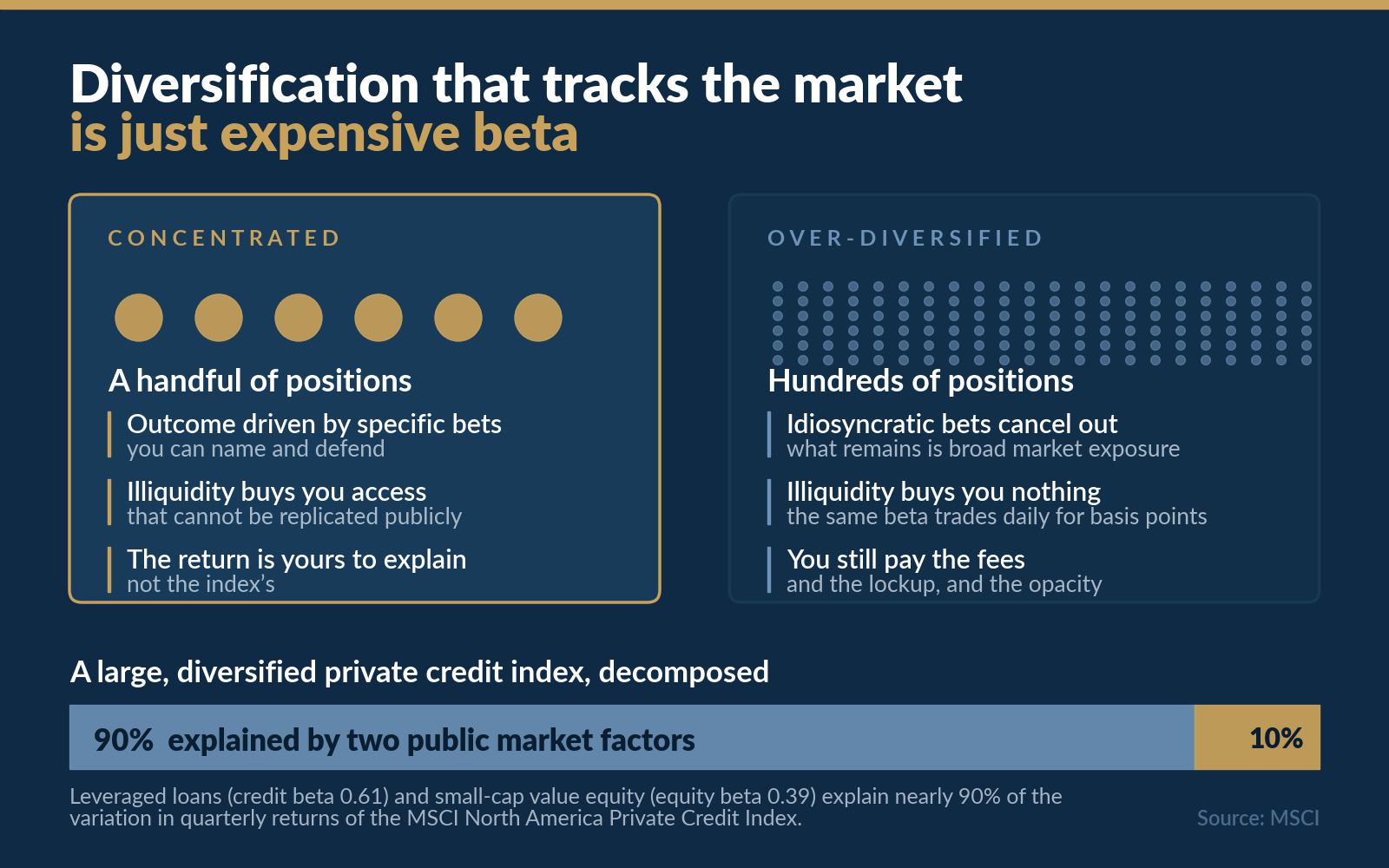
A common failure mode in alternatives is the portfolio that becomes so diversified it starts behaving like a less liquid version of public market indices.
When a private equity fund, a multi-strategy hedge fund, or a “private credit” vehicle ends up with hundreds of underlying positions across dozens of sectors, the idiosyncratic bets cancel out. What remains is exposure that correlates highly with broad market moves, only with longer lockups, higher fees, and far less transparency. You have paid a premium for illiquidity and opacity without receiving the concentration that was supposed to justify those costs.
In public markets, you can buy diversified beta cheaply and exit in seconds. In alternatives, the same diversification often leaves you with a more expensive, less liquid version of the same thing. That is not alpha. It is friction.
Conviction is the only real justification
This is the part most people skip.
The structural disadvantages of alternatives (opaqueness, illiquidity, limited information rights, longer capital lockups, and the absence of daily pricing) are real costs. They are not features. To accept those costs, you need a corresponding belief that is strong enough to outweigh them.
That belief can take different forms. It can be conviction in a specific asset class (certain types of private credit in a high-rate environment, or venture in a particular technology cycle). It can be conviction in a theme (AI infrastructure, defense, energy transition). It can be conviction in a manager’s process or access. Or it can be conviction in a single underlying company or opportunity where you believe the risk-reward is meaningfully asymmetric.
Without that conviction, the decision to allocate to alternatives becomes hard to defend. You are accepting worse liquidity and less visibility for what may amount to market-like returns with extra friction. That is a poor trade.
Public markets let you change your mind daily. Alternatives require you to live with your thesis for years. That only makes sense if the thesis is strong enough to carry the weight.
How we think about it at Cohesion
At Cohesion Partners, our approach to alternatives is deliberately narrow.
We look for very highly skilled people working in specific areas of the market. Breadth is not the goal. Depth and edge are.
We focus on downside loss rather than being seduced purely by upside. The question is not how much we might make if everything goes right. It is how much we can lose if things go wrong, and whether that loss is acceptable relative to the opportunity.
And we always ask ourselves: who buys us out of our position, and how? If we cannot clearly articulate the path to liquidity (strategic acquirer, later-stage capital, IPO, or secondary market), we pass. Illiquidity without a realistic exit path is not a feature. It is a risk that needs to be priced.
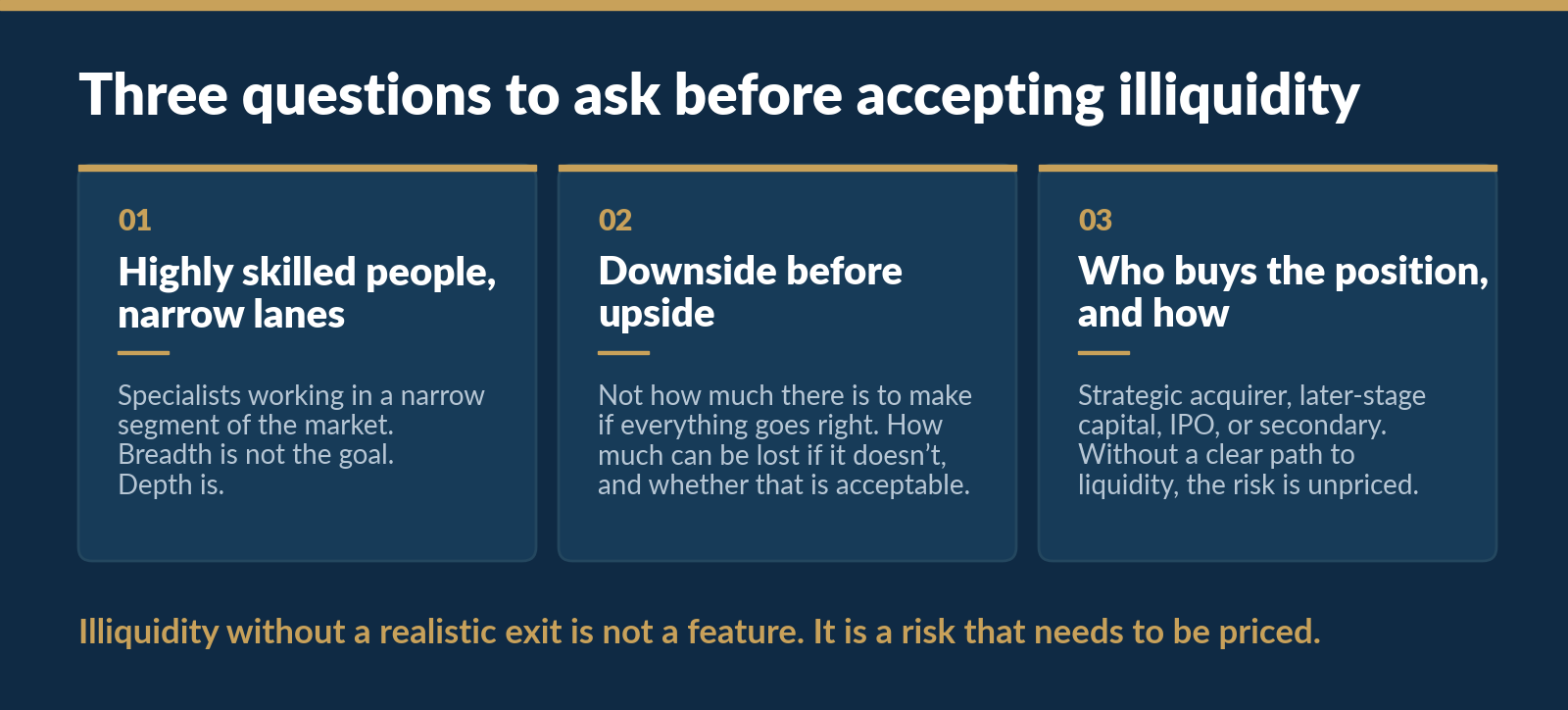
These filters keep us from chasing the broad, diversified alternative portfolios that end up looking like expensive versions of public market beta. They force us to have real conviction before we accept the structural disadvantages that come with private investing.
The real question
The useful question is not “Should I own alternatives?”
It is “Do I have enough conviction in a specific opportunity, theme, or process to justify the structural disadvantages that come with it?”
If the answer is yes, alternatives can be a powerful way to express that view. If the answer is no, or if the allocation is driven by the vague sense that “everyone else is doing it,” then the risks are unlikely to be compensated.
Risk does not disappear because the investment is private. It just becomes harder to see. The investors who do well in alternatives are usually the ones who accept that reality and still choose to take the risk anyway, because they believe something specific is worth it.
-cg