
Is AI a threat to your business? Good.
For owners in disruption-prone industries, AI could be the shortest path to a bigger exit.
When speaking with white-collar executives and business owners, it’s not uncommon for me to hear a version of this line:
“My clients/customers are old school. They don’t use tech. My business is safe.”
It’s one of the most dangerous things an owner can say about their company.
The folly of “my clients don’t need tech”
If your clients don’t use tech, you can’t scale. Every hour of service is tethered to a human, every client relationship lives in somebody’s head, and every new account you win comes at the cost of another one you can barely service. That isn’t a moat, that’s a ceiling.
Businesses that resist technology don’t stay the same size forever. They shrink, slowly, as the next generation of clients quietly drifts toward firms that can deliver faster, cheaper, and more transparently. You don’t lose your client book overnight. You lose it through attrition.
Employees, take note
The same red flag applies on the other side of the ledger. If you work at a firm that treats AI as someone else’s problem, your clients are slowly moving toward competitors with better tools and a sharper client experience. Those competitors grow faster. They hire more, invest more, and compound their lead every quarter.
Your firm, meanwhile, fights harder each year just to hold ground. That dynamic doesn’t end well for anyone riding in the back seat, potentially translating into fewer promotions, thinner bonus pools, less budget for the tools that actually make your job easier, and a whole lot more “do more with less.” Shrinking businesses cut first and ask questions later.
Scale is the whole game
Scale creates growth. Growth creates incremental profits. Incremental profits increase enterprise value. That is the entire math of building something worth selling.
A service business doing $5M in revenue at 20% margins is worth one multiple. That same business doing $5M at 35% margins because AI took the busywork out of onboarding, reporting, and client service, etc., is worth a completely different multiple. Not just more profit. A better multiple on that profit. The buyer is paying for operating leverage, and AI is the cheapest way to manufacture it right now.
AI is finally a real lever
Five years ago, most small and mid-size firms couldn’t realistically deploy “technology” in any meaningful way. Custom software was expensive, integrations were brittle, and the payback period was measured in years.
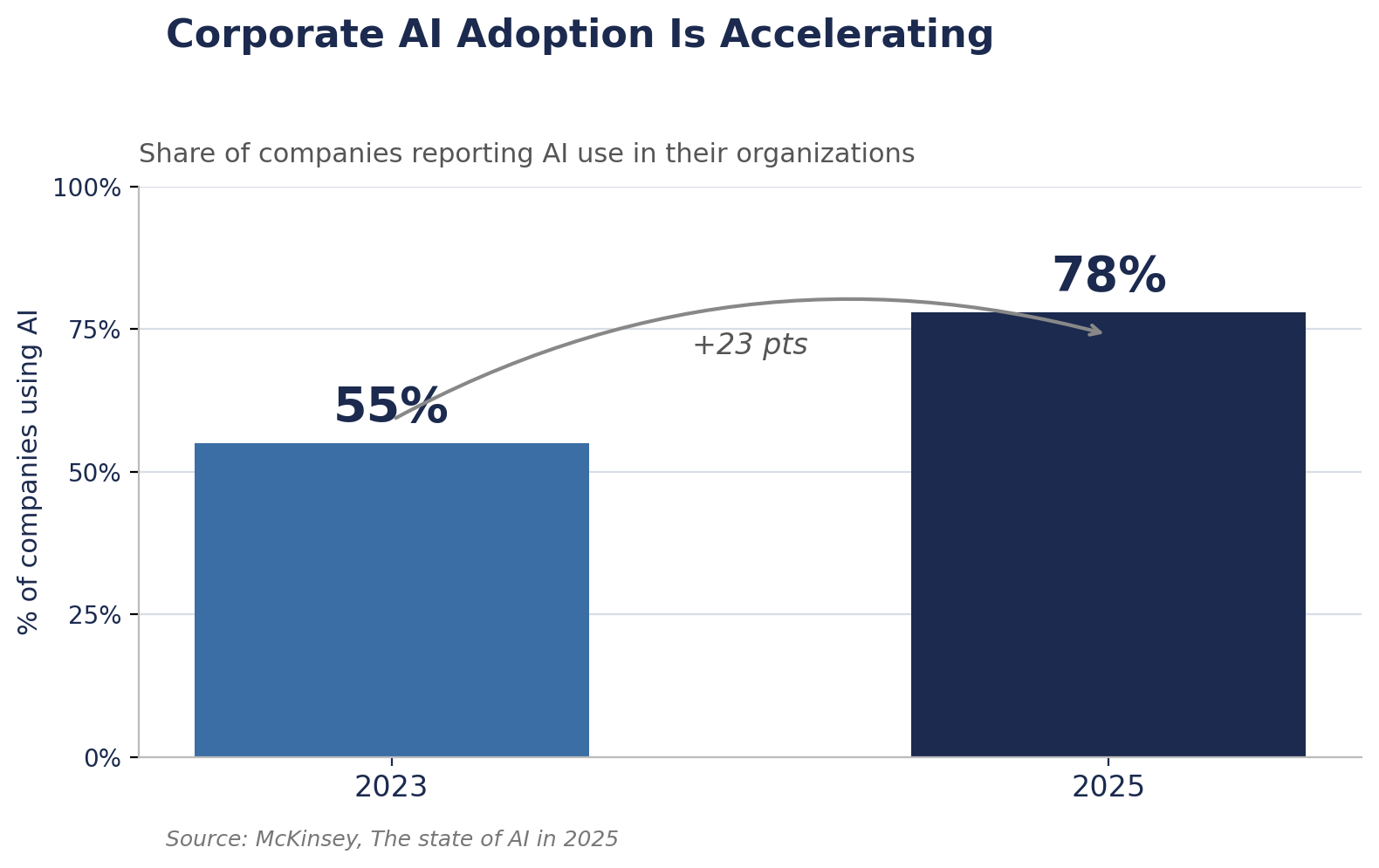
That has changed. AI can now draft the first version of a legal brief, summarize a 200-page discovery document, reconcile a client ledger, handle 80% of inbound client questions, onboard a new account without a human ever touching a form, and surface the three deals in your pipeline that actually deserve attention today. McKinsey’s 2025 State of AI survey puts corporate AI adoption at 78% of companies — up from 55% just two years earlier — with the biggest revenue lifts showing up in sales, marketing, and service operations. For the first time, a 15-person firm can operate like a 50-person firm……without hiring the other 35 people.
Source: McKinsey, The state of AI in 2025
Costs down, throughput up, experience better. Pick any two; AI often delivers all three.
Buyers are watching
Here’s what the market is quietly figuring out: businesses that have genuinely integrated AI are becoming premium acquisition targets. Private equity and strategic buyers don’t just want your revenue, they want your playbook. If you’ve already figured out how to serve twice as many clients with the same headcount, a sophisticated acquirer can roll that model across a dozen similar businesses and compound the advantage overnight.
The data backs this up. FTI Consulting reports that 59% of private equity funds now view AI as a key driver of portfolio value creation. PwC has similarly observed that portfolio companies with well-defined AI use cases and demonstrated ROI are increasingly commanding premium multiples over peers still just talking about AI. The laggards are getting passed over or bought cheaply and retooled by someone else.
Cheaper doesn’t mean smaller
There’s a deeper economic argument worth flagging here. When the cost of professional work falls, the total market for that work tends to expand, not shrink. Apollo’s chief economist Torsten Slok recently called this the “Jevons employment effect,” after the 19th-century paradox that more efficient steam engines didn’t cause Britain to burn less coal, it caused them to burn far more.
The same dynamic is now playing out in professional services. As AI makes legal work, accounting, consulting, and financial advice cheaper to produce, more clients can afford it, more problems become worth solving, and more new firms get launched. Slok points out that weekly US business formation is sitting at the highest levels in American history, and that the unemployment rate is falling faster for younger workers than older ones, both consistent with an industry getting bigger, not smaller.
Cheaper inputs don’t shrink industries. They grow them. The only real question is whether your firm will be one of the operators capturing that growth, or one of the laggards losing share inside it.
Rethink the question
So when an owner asks, “Is AI coming for my job?”
The better question might be:
“Is AI coming for my enterprise value?”
If the answer is yes, that isn’t a threat. That’s an opportunity to build something worth considerably more than what you’re running today. The owners who lean in now will spend the next five years widening the gap. The ones who keep insisting their clients “don’t need tech” will spend the next five years shrinking.
The gap between AI adopters and laggards is widening by the quarter. The question is which side of it you want to be on in five years.
-cg